
"What happened today? Just write a few lines, no pressure~"
That was the message AI sent me every night at 11, for 35 days.
At first I'd happily think back over the day and write it down. Then came the days when I still hadn't made sense of yesterday and the next one had already arrived. By the end it was nag nag nag nag nag, enough already! Watch me clear that little red dot and ignore you! Hmph!
Well, I did set that reminder myself...
By September, I realized I'd gone two full weeks without writing anything new.
The truth is I've been keeping records on and off for maybe 25 years. I started keeping a diary in third grade. Back then it was paper notebooks. Every so often after school I'd go to the bookstore and pick out a pretty notebook to write my diary and stories in. Over the years those notebooks filled several drawers, full of everything that happened to me growing up.
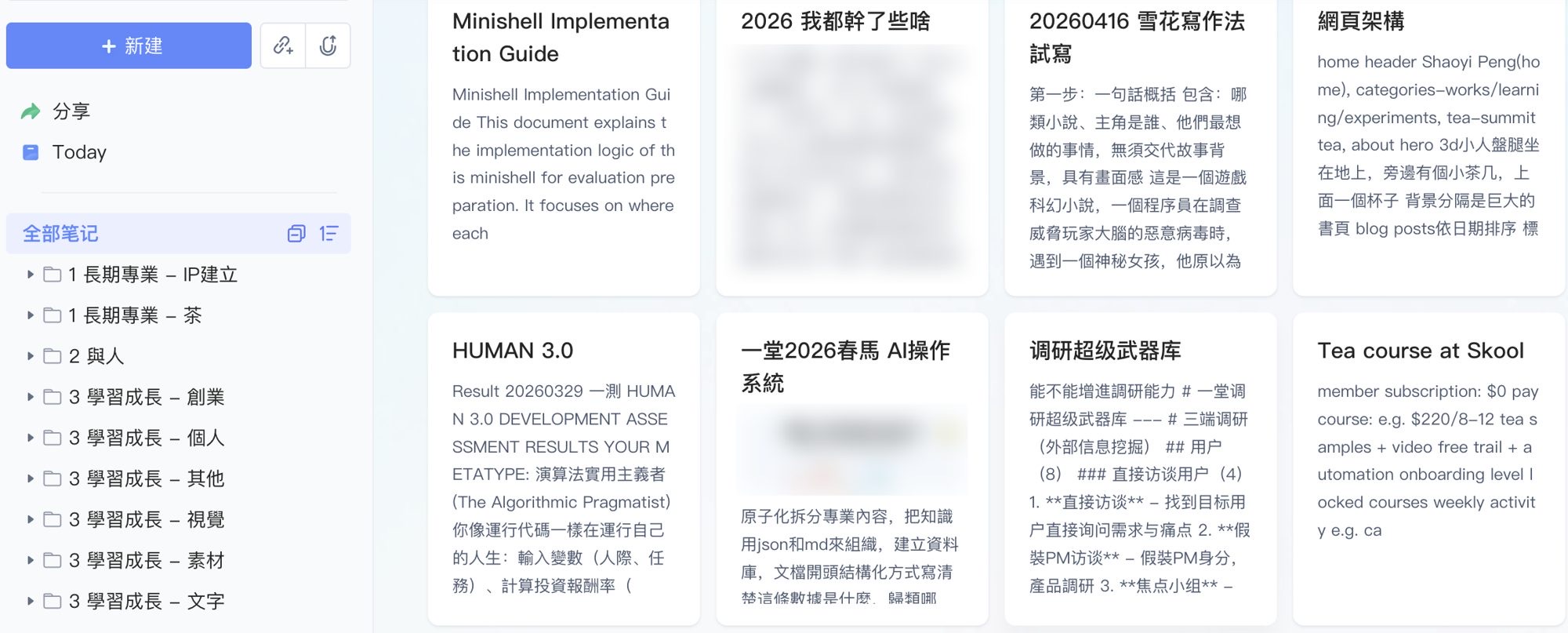
In middle and high school I tried switching to typing, keeping it in Word files on my computer, but as a student I was busy as a dog, so it was always on and off. Later, when I started my own company, I began using Youdao Cloud Notes, a Chinese note-taking app. Things I'd been through, documents for work, articles I liked, thoughts and takeaways, reference material: all of it went into notes, 1,186 of them so far.
The reason it always broke off: in all those years of recording, I never had a fixed output mechanism to force the input. "Input" mostly went like this: hehe, something fun happened today, let me write it down; ugh, so lazy, don't feel like it; huh, what happened yesterday? Meh, can't remember, forget it. A few times I tried to build a fixed habit, went back and forth, and every attempt fizzled out. To this day I'm basically doing sit-ups: "Yes, I can do this again!" "Nope, I can't anymore."
Then AI came along.
At the end of July this year, I had AI ask me every night about the day's thoughts and progress. I'd write down whatever was worth recording and it would file it; at the weekend it would also sum up what I'd written that week, and even shape it into something publishable, so output would drive input!
The result was those 35 days at the start. Even with AI reminding me kindly every day, as long as I still had to type things in myself, oops, the seven deadly sins of human nature (mine) came out.
Pinning my hopes on people (me) being self-disciplined was clearly unrealistic.
So I thought it through a bit further: if asking me what I'd done wasn't working, why not give it a fixed set of rules and let it collect things automatically every day? Most of what I do now happens in Claude Code and Codex, so I had it scan my conversations with AI every day, the tasks, the thinking and the replies, and pick out the important decisions I made that day and what I learned.
Once collecting was fully automated, wow, the whole process finally ran smoothly!
One thing still needed fixing. Originally I had it turn everything it collected into an article automatically once enough had piled up. But I found that the articles AI wrote still had a heavy AI flavor.
That got me thinking: what matters most in writing?
Writing for others to read was never the point. The point is whether, while writing, I can spark new collisions of ideas, and whether filling in the gaps deepens my understanding of the subject. What matters most is still how I process the information. It has to start from my own thoughts, and AI can't do that for me. If writing is just about producing output, and it doesn't matter who writes it, then writing loses its meaning completely. It becomes a fake show of prosperity, or purely about commercial gain, which goes against why I started recording my thinking in the first place.
Once I saw that path wouldn't work, I changed my approach: I look at the thoughts on a topic that AI has collected for me over time, and retell them in my own words.
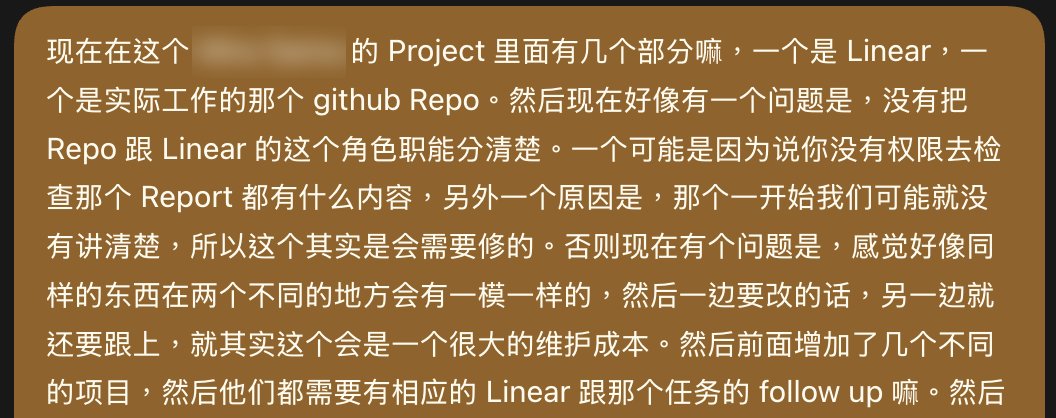
What I do now I call "spouting" (口噴 in Chinese, literally "mouth spray"): everything goes in through AI voice input. I use a small product I built myself, running on GPT-Live underneath, though the voice tool built into an AI app works too. The point is to say it out loud instead of typing.
In my tests, I can say about 1,700 Chinese characters in roughly 8 minutes. When I used to write fiction, the same amount took at least an hour and a half.
The upsides are many:
-
Spouting puts you in a flow state, a natural conversational stream. Typing makes you instinctively condense your words. My writing habits aren't great: I take one step and look back three, agonizing over "suppose" or "believe", "improve" or "enhance", "halt" or "cease". These trivial details keep cutting off my train of thought, and I can't turn what's in my head into words fully and directly.
-
Say whatever comes to mind, then let AI restructure it afterwards; that's what it's good at anyway. I don't have to worry about rambling, picking the exact word, or typos. The only thing I need to think about is digging out everything in my head on the topic.
-
Talking itself stimulates thinking. A lot of the time, ideas get sparked in the middle of speaking, as if some region of my brain suddenly lights up. If I just mull it over quietly without saying it out loud, I can never quite think it through or sort it out.
It's like the idea of learning by teaching: when we teach others or retell something, that's when we really organize what we know about a subject and test whether we actually understand it. It's easy to read something, think you've mastered it, and then find you can't explain it at all.
25 years of sit-ups, and this time someone's finally holding my feet, haha!